
What I Learned About AI, Technology and DSOs at the DSO Technology Summit
I just got back from the DSO Technology Summit in Nashville, where I sat in a room with DSO leaders, operators, technologists, investors, consultants, and vendors working on som...
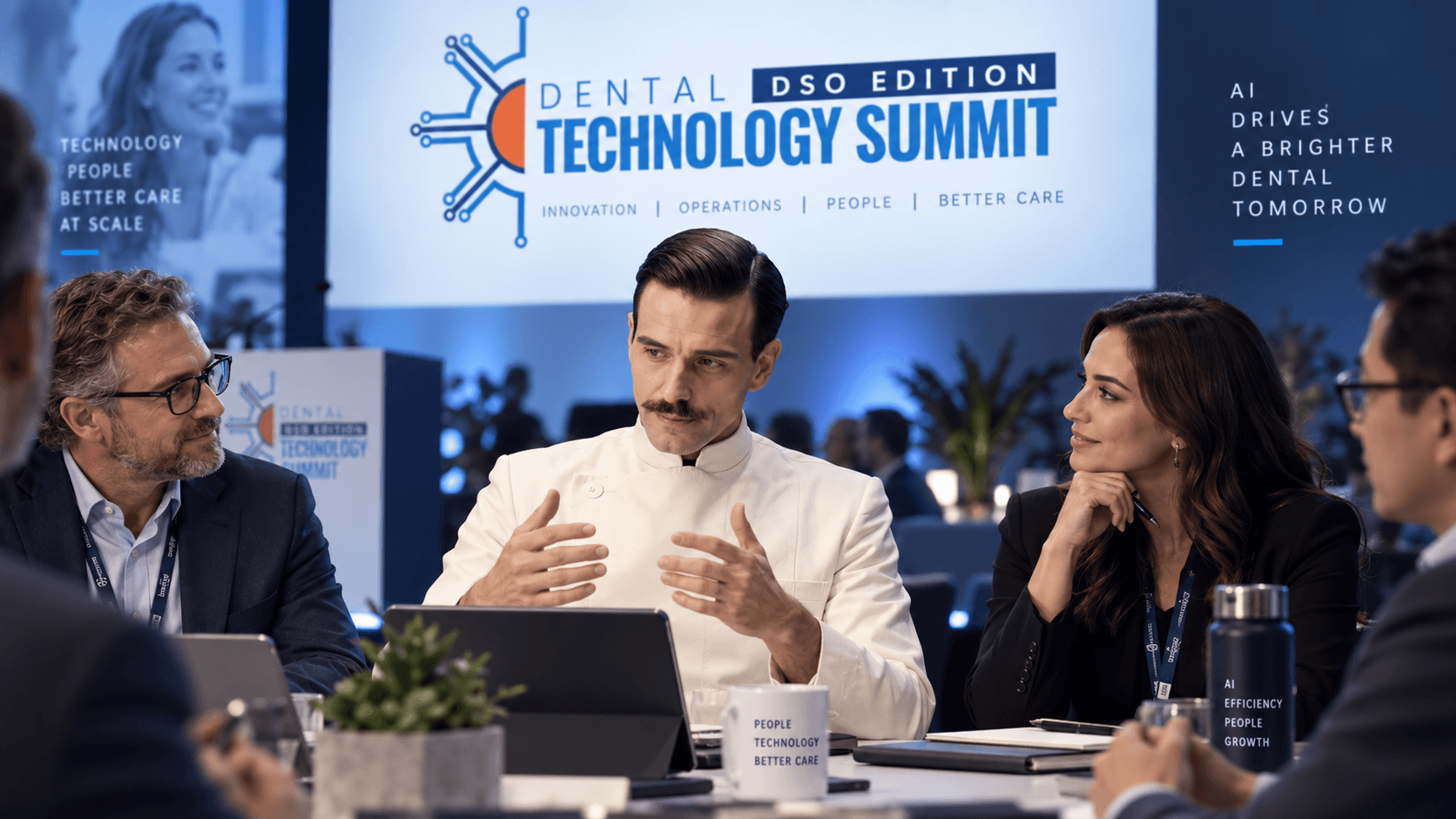
I just got back from the DSO Technology Summit in Nashville, where I sat with DSO leaders, operators, technologists, investors, consultants, and vendors tackling some of the biggest problems in dental operations.
The event was small by design, which made it especially useful. Instead of getting lost in a massive trade show, you could actually talk to people, compare notes, and hear directly from teams trying to solve real operational problems inside growing dental organizations.
After spending time listening to presentations and speaking with people across the industry, one takeaway stood above the rest:
DSOs do not have a shortage of technology. They have a shortage of clarity around what technology to deploy, how to implement it, and how to make sure it actually produces measurable ROI.
That theme showed up repeatedly throughout the summit.
Everyone Is Trying to Improve the Technology Stack
Every DSO seems to be searching for ways to make the organization more efficient.
That includes improving operational visibility, reducing manual work, automating repetitive processes, coordinating across many locations, and deploying technology employees actually use.
The challenge is that a DSO can span dozens or hundreds of practices, sometimes across multiple verticals such as general dentistry, pediatrics, implants, or specialty care.
That creates an enormous coordination problem.
A technology decision that looks simple at one location can become extremely complicated once it has to work across an entire organization.
That leads to a larger question:
Does adding more technology actually make the DSO more efficient, or does it create operational drag?
Implementation Is Often the Real Bottleneck
One of the strongest themes from the event was that implementation is frequently harder than purchasing the technology itself.
There are already plenty of vendors.
AI is now creating even more pressure because organizations feel like they need to adopt quickly or risk falling behind. But deploying AI irresponsibly across a large DSO can create just as many problems as it solves.
AI can help organizations make decisions faster.
That creates leverage.
But if the inputs, workflows, or underlying assumptions are wrong, it can also help an organization make bad decisions faster.
The real question is not:
How do we use AI?
It is:
Which problems should we solve first, how do we prove ROI, and how do we scale the solution across the organization in a way employees will actually adopt?
That is a much harder problem.
The chain looks something like this:
Technology → Implementation → Adoption → Behavior Change → Operational Outcome
If any part of that chain breaks, the technology's value drops dramatically.
AI Is Here, But There Is No Clear Playbook
AI was obviously top of mind throughout the summit.
What stood out was how different the level of maturity was across organizations.
Some DSOs were already building internal AI tools and deploying custom workflows.
Others were testing AI slowly.
Some had spent significant money without seeing clear results.
Others knew they needed an AI strategy but were still unsure where to start.
This is not surprising.
AI is moving much faster than most enterprise organizations can realistically adapt.
The technology is powerful, but organizations still need humans who understand the business, understand the workflows, and know where AI can actually create value.
That is the gap.
The future will not simply belong to the organizations using the most AI.
It will belong to the organizations that deploy it most intelligently.
Data Is Still a Major Problem
Another recurring theme was data.
DSOs already have enormous amounts of it.
The challenge is understanding which data matters.
As organizations scale, there are more practices, more systems, more departments, and more KPIs. Different teams also need different views of the business.
Operations may care about one set of metrics.
Doctors may care about another.
Marketing, sales, and finance may each need something completely different.
The challenge becomes less about extracting data and more about translating it into something useful.
At Shared Practices Group, we have seen this firsthand while building Root Data. What started as a data analytics product has increasingly become a way for different teams to understand performance, create accountability, and identify where to focus next.
That is where AI becomes especially interesting.
AI can help move organizations beyond static dashboards by identifying patterns, highlighting anomalies, and helping teams understand where to focus.
The goal should be faster clarity.
Dentistry Is Still Behind on Digital Transformation
One of the opening presentations made the point that dentistry is still several years behind other industries when it comes to digital transformation.
I heard similar comments from multiple people throughout the summit.
That is not necessarily an insult to the industry.
Healthcare is complicated.
Dental organizations have regulatory requirements, legacy systems, fragmented software, and complex operational workflows.
But one thing kept standing out to me:
There are a lot of IT professionals in dentistry.
There appear to be far fewer product people.
That distinction matters.
IT is focused on making technology function securely and reliably.
Product is focused on questions like:
- What problem are we actually solving?
- Who inside the organization has this problem?
- How does this fit into their workflow?
- Will they actually use it?
- What needs to change after deployment?
- How do we improve the product based on behavior?
A good product owner does not simply ship technology and tell employees to figure it out.
They understand the technology, the workflow, and the psychology of the user, and then continually improve the system around them.
That kind of thinking will become increasingly important as AI becomes embedded into more DSO workflows.
Vendor Fatigue Is Real
There are a lot of dental technology vendors.
Many operators are tired of hearing promises about the next platform that is going to transform their organization.
Even if the technology is good, deploying a new system across a large DSO can require months or even years of work.
That means the cost of selecting the wrong vendor is much larger than the subscription price.
It includes:
- Implementation time
- Training
- Integrations
- Internal resources
- Workflow disruption
- Employee resistance
- Lost organizational focus
One DSO operator described leadership saying they wanted to “weave AI into everything.”
But the obvious question remained:
Who is actually going to do that?
Without clear ownership, broad technology mandates do not mean much.
Trust Matters More Than I Expected
This was probably one of the most interesting lessons for me personally.
Coming from the broader technology world, I tend to think about software in terms of product quality, functionality, speed, and ROI.
But the DSO world is heavily relationship-driven.
One of the most memorable slides at the summit showed how strongly vendor decisions can be influenced by whether people actually like and trust the person they are working with.
At first, that seemed surprising.
Then it started to make perfect sense.
When a technology implementation could take six months or a year, you are not just buying software.
You are entering a relationship.
You are trusting someone to understand your organization, help you navigate complexity, solve problems when things break, and potentially change how hundreds of employees work.
Trust becomes part of the product.
The DSO Community Is Smaller Than It Looks
The DSO world is also surprisingly small.
Once you narrow the market down to DSO leadership, technology teams, operators, consultants, and investors, you begin seeing the same people repeatedly.
People know one another.
The distribution loop may look less like traditional SaaS and more like:
Relationship → Trust → Proof → Referral → Adoption
This also explains why smaller conferences can be so valuable.
Why the DSO Technology Summit Worked
The event was capped at roughly 75 people, which created a much more intimate environment than a typical industry conference.
That made it possible to have real conversations rather than simply collect business cards.
You could speak directly with operators dealing with implementation problems, vendors building products, consultants helping organizations deploy technology, and investors trying to understand how these systems affect operational performance.
For me, that was the biggest value of the event.
The presentations were useful.
The Bigger Takeaway
AI is dramatically lowering the cost of building software.
That means there are going to be more applications, more vendors, and more technology choices than ever before.
But easier software creation does not make enterprise implementation easier.
If anything, it may make the selection problem worse.
DSOs will increasingly need people and companies that can separate signal from noise.
They need partners who understand the technology, understand dentistry, understand operations, and can prove that what they are deploying creates measurable value.
That creates a different kind of competitive advantage.
For us at Root Data, that reinforces the direction we have been moving toward.
Because the ultimate value of technology is not the technology itself.
It is what the organization can do better because of it.
Want more insights like this?
Connect your practice management system to Root Data and get clear, actionable insights on your production, collections, and hygiene.
Explore Root Data