
The Self-Operating Dental Practice: What Comes After Dental Practice Management Software
There are systems for scheduling, phones, insurance, accounting, marketing, reporting, patient communication, payments, and dental practice management. Dental analytics platforms have made it easier for owners and Dental Service Organizations to understand what is happening across their practices.
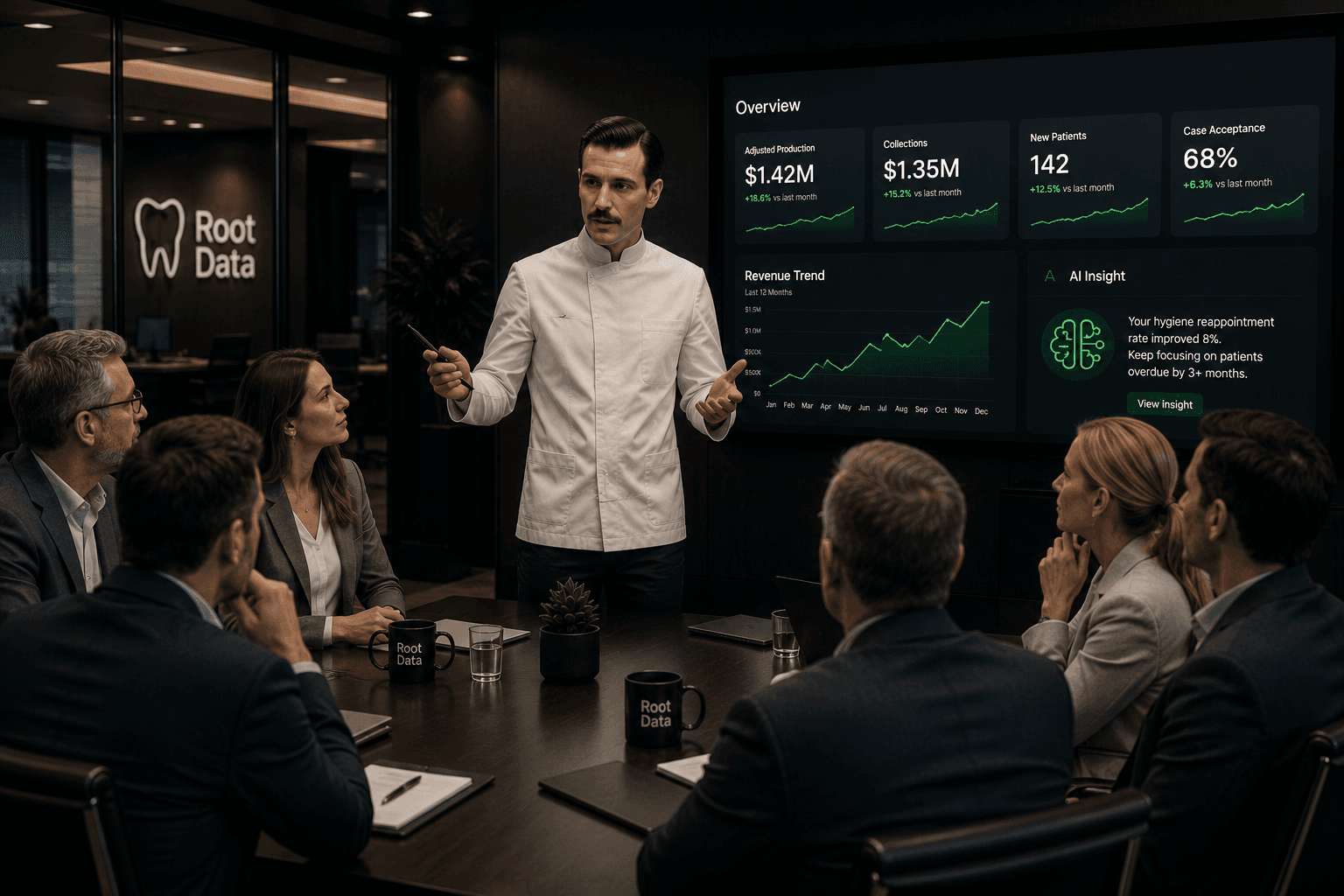
Dental practices have more software than ever.
There are systems for scheduling, phones, insurance, accounting, marketing, reporting, patient communication, payments, and dental practice management. Dental analytics platforms have made it easier for owners and Dental Service Organizations to understand what is happening across their practices.
However, the daily task of connecting those systems still relies on people.
Teams transfer information between platforms, check statuses, chase tasks, compile reports, follow up with patients, and repeatedly resolve the same operational issues. Owners and managers become the last point of contact whenever something goes wrong.
The software stack has expanded.
The operating model has not.
The next phase of dental technology won’t be defined by another dashboard or another application for the team to handle. It will be defined by the self-operating dental practice: a practice where routine operations occur quietly in the background, systems share context, and people can focus more on patients, leadership, and growth.
Your Team Should Not Be the Integration Layer
Most dental software was designed to handle one specific function.
The practice management system stores patient, appointment, and production data. The phone platform tracks calls. Insurance tools manage claims and eligibility. Marketing platforms generate leads. Dental analytics software compiles performance data into reports and dashboards.
Each system may function well on its own. The issue lies in how they connect.
A missed call needs to prompt follow-up. A marketing lead should turn into a scheduled appointment. A completed appointment must link to production and collections. An unpaid claim needs to be identified, routed, and resolved.
In many practices, people still handle these transitions manually.
This leads to delays, inconsistency, and unnecessary administrative costs. It also hinders growth. Every hour spent moving information, checking systems, or following up on routine tasks is time the team cannot dedicate to patients, service, leadership, or higher-value work.
A self-operating practice alleviates much of that burden.
What Is a Self-Operating Dental Practice?
A self-operating dental practice is not a practice without people.
It is a practice where people are no longer required to coordinate every routine interaction between systems.
In a self-operating practice:
- Systems share the context required to work together
- Repeatable workflows happen automatically
- Important exceptions reach the right person
- Dental analytics identify what requires attention
- Leaders see what matters without searching through reports
- Teams spend less time operating software
- Growth does not require the same increase in administrative complexity
The goal is not automation for its own sake.
The goal is to create a practice that can grow faster, increase revenue, improve profit margins, and support more patients without placing more operational weight on the owner and team.
From Dental Analytics to Intelligent Action
Traditional dental analytics help practices understand what has already happened. That visibility is important, but it is only the beginning.
The next step is connecting analytics to action. An intelligent system can identify where the new-patient conversion process is breaking down. It can alert the right person and initiate the appropriate follow-up workflow.
Instead of just showing that collections are falling behind production, the system can identify aging claims, route exceptions, and trigger the next step.
Dental analytics for DSOs can surface the locations, providers, and workflows that need immediate attention, eliminating the need for a DSO leader to compare dozens of reports manually.
The dashboard becomes less important. The response becomes more important.
The Goal Is Growth, Not More Technology
Technology only matters if it creates leverage.
A new dental practice management tool that adds another login, report, or workflow may create more work rather than reduce it. The value comes when technology helps the practice capture more opportunities and operate more efficiently.
That could mean:
- responding to missed calls faster
- following up with new patients automatically
- filling open schedule capacity
- reactivating overdue patients
- identifying unpaid claims earlier
- routing tasks to the correct team member
- connecting marketing activity to completed treatment
- giving leadership a clear view across multiple locations
Each improvement can affect revenue, profitability, or team capacity.
The self-operating practice changes the relationship between growth and overhead.
Traditionally, more patients create more calls, appointments, claims, follow-up, reporting, and coordination. More locations create more management layers and centralized administrative work.
Intelligent systems can absorb more of that repeatable work, allowing the same team to support more patients, oversee more locations, and capture more revenue without adding equivalent overhead.
The result is not simply a more automated practice.
It is a more profitable and scalable one.
How the Transition Happens
A dental practice cannot become self-operating by installing a generic AI assistant.
AI needs reliable data, access to the systems where work happens, and enough context to understand how the organization operates.
The transition happens in three stages.
- Connect the Practice
The first step is bringing together the data and systems behind dental practice management, scheduling, insurance, accounting, marketing, patient communication, and performance reporting.
This gives AI a connected view of the organization instead of isolated information from separate platforms.
For multi-location organizations, this also creates a stronger foundation for DSO dental analytics by standardizing visibility across practices.
Without connected data and context, automation remains shallow and unreliable.
- Map the Work
Every dental organization has different workflows, approvals, priorities, and exceptions.
The next step is identifying where work slows down, where information gets lost, which tasks repeat, and which decisions require unnecessary coordination.
The goal is not to automate everything.
It is to identify the work that should no longer depend on constant human intervention.
- Automate and Expand
Once the systems and workflows are connected, intelligent automations can begin monitoring activity, completing repeatable tasks, coordinating between platforms, and escalating exceptions to the right person.
As the organization grows, more workflows can be added and improved.
The system becomes more valuable over time because it gains better data, deeper context, and a clearer understanding of how the practice operates.
What Could Run in the Background?
Opportunities for intelligent automation will vary across organizations, but several key areas are particularly well-suited for implementation.
In the front office, this could involve appointment confirmations, follow-ups on missed calls, outreach to new patients, recall and reactivation efforts, and follow-ups on unscheduled treatments.
In insurance and revenue-cycle operations, potential applications include eligibility verification, monitoring claim statuses, following up on denials, posting payments, managing accounts receivable workflows, and tracking patient balances.
For marketing, automation can enhance lead routing, follow up on calls and forms, track appointment conversions, and connect marketing sources to production and collections.
In dental practice management, it can support recurring reporting, task routing, location comparisons, provider monitoring, operational alerts, and exception management.
For dental service organizations (DSOs), connected dental analytics can help leadership identify performance variances across locations, while automation simplifies routine coordination tasks.
The key takeaway is clear: automating routine tasks enables individuals to concentrate on decisions that require judgment, empathy, and leadership.
More Time for People
The goal of automation is not to eliminate people from dentistry.
It aims to free up skilled individuals from repetitive tasks that systems can manage.
Dentists should dedicate more time to patient care. Front-office teams should enhance service quality. Managers should focus on coaching their teams rather than just compiling reports. Owners should concentrate on growth, culture, and strategy instead of being the final point of contact for every operational issue.
People should engage in work that fosters human connection.
The rest should operate smoothly in the background.
The Advantage Will Compound
The transition to AI-driven businesses is already underway.
The practices that will see the greatest benefits are those that integrate AI with their dental practice management systems, operational data, analytics, and workflows.
Over time, these practices will develop cleaner data, more organized processes, quicker decision-making, reduced administrative costs, and increased capacity for growth.
This advantage compounds.
The sooner the foundation is established, the more rapidly the practice can adopt a model where automation is prevalent, and growth becomes more manageable.
What Root Data Is Building
Root Data is creating the intelligence and automation layer behind the self-operating dental practice.
We connect dental analytics, practice systems, and operational workflows, then work with single practices, multi-practice groups, and DSOs to identify and automate the processes creating the greatest drag on growth.
The goal is not to add another piece of dental practice management software for your team to manage.
It is to help more of the practice manage itself.
What Should Run Without You?
Where are repetitive work, disconnected systems, or manual coordination slowing down your practice?
Root Data can help identify the highest-value workflows to automate and map a path toward a faster-growing, more self-operating dental practice.
Contact us if you're ready to take the next step.
Want more insights like this?
Connect your practice management system to Root Data and get clear, actionable insights on your production, collections, and hygiene.
Explore Root Data