
Introducing Root Data for Dental Support Organizations
Root Data was developed alongside a $100M dental support organization and is used in all 50 of their practices. Regional managers, marketing teams, founders, and doctors use it daily to run their operations. Now, we're making it available to other multi-location groups.
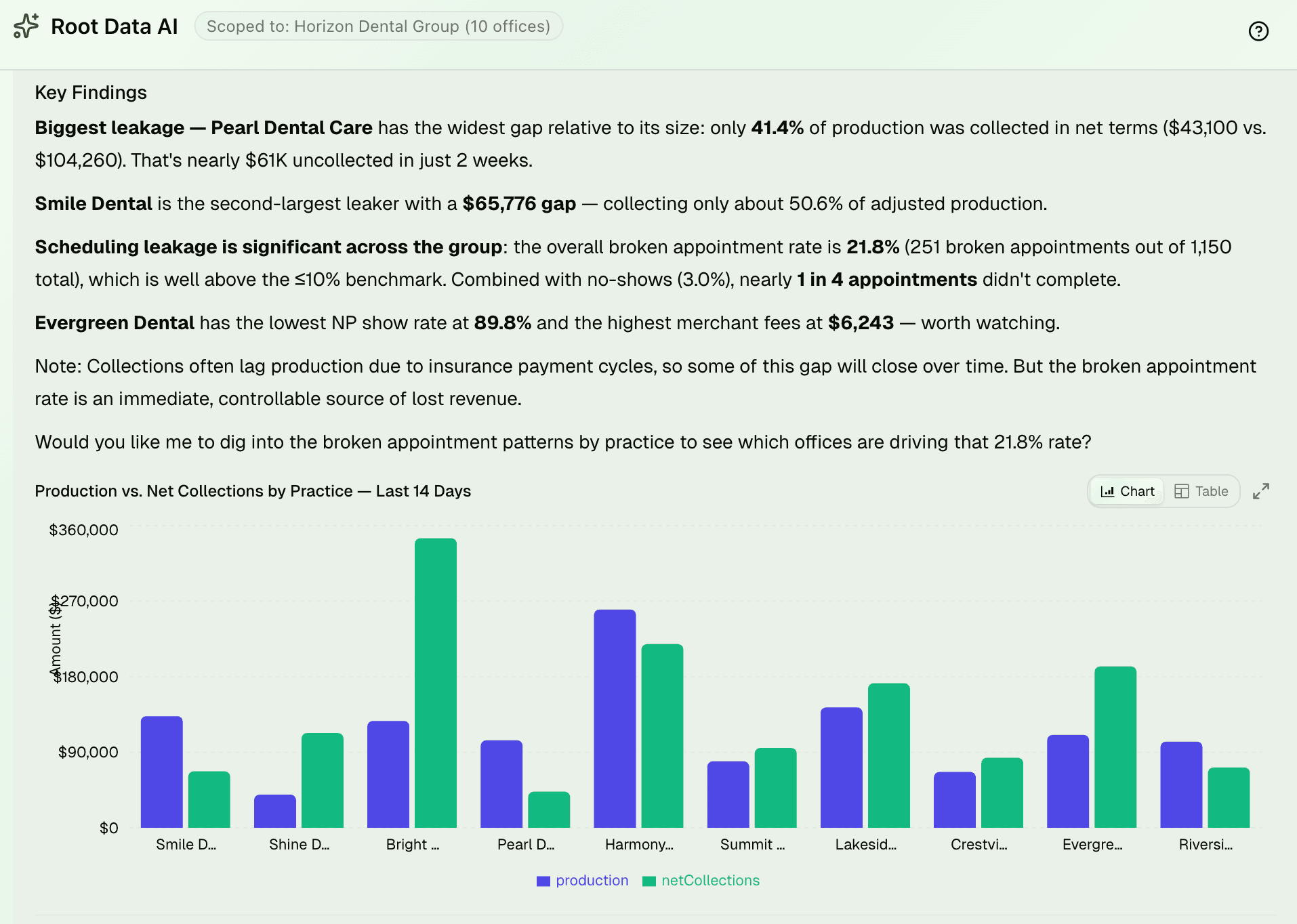
Root Data was developed alongside a $100M dental support organization and is used across all 50 of their practices. The system is used daily by regional managers, marketing teams, founders, and doctors to run their operations. We are now making it available to other multi-location groups.
Root Data for Dental Support Organizations provides DSOs with revenue leak detection at each location, group-level KPI summaries, and an AI chat interface that answers practice data questions in seconds. It directly connects to your PMS at every location, eliminating the need for spreadsheets.
Quick Note: Check out the DSO demo dashboard.
Many DSOs have a lot of data but lack visibility into their operations. Production reports are generated from Open Dental at each location, then exported to a spreadsheet. The spreadsheet is sent to the regional manager, who creates another spreadsheet. By the time the information reaches the executive team, some of the numbers are outdated, and others are incorrect.
The DSO data problem
The bigger your group gets, the worse your data gets. This might sound surprising, but it's true.
A single practice owner with one location can easily keep track of what's going on. They can see which patients aren't rebooking, which hygienists are running behind, and which providers are over-adjusting. But as soon as you add a second location, that changes. By the time you have three or four locations, you're making decisions based on old information and instinct.
The problems add up as you grow:
Case acceptance variance. One location might accept 68% of proposed treatment, while another accepts only 41%. But at the group level, nobody knows this.
AR aging by location. If three locations have insurance accounts receivable that are over 90 days old, that's a lot of money that's essentially stuck. And it won't show up on your profit and loss statement.
Hygiene reappointment. If one location's reappointment rate drops from 92% to 78%, that's $80,000 in lost production per year. But you won't see that in your monthly reports.
Write-off and adjustment variance. One office might have adjustments that are 3% of production, while another has adjustments that are 11%. The office with 11% adjustments isn't just giving away discounts - their team probably doesn't know how to use the codes correctly.
The numbers can be devastating at the group level. If each location is losing six figures, and you have 5, 10, or 25 locations, that's the difference between meeting your goals and missing them.
Root Data, Built for Dental Support Groups
Root Data is the dental analytics layer that sits on top of every location in a dental support organization, explaining in plain English where your money is going.
It doesn't replace Open Dental or your billing team. Instead, it connects to the data from these systems and turns it into actionable information that a regional manager can use today.
Here's what you get with the DSO release:
Per-location revenue leak detection
Each leak is quantified, ranked by dollar impact, and tied to the responsible location and provider. This means you stop debating which locations are underperforming and start discussing what to do about it.
Group-level KPI rollups
You get key metrics like production, collections, net collection rate, days in AR, case acceptance, hygiene reappointment, and new patient counts. These roll up by group, and you can drill down to location and then to provider. All the dental metrics that impact EBITDA are in one place, updated from Open Dental in near real-time.
AI chat for ops teams
Ask a question in plain English, like "Which locations had the biggest drop in hygiene production last month?" or "How much insurance AR is over 60 days at the Tampa office?" You get an answer with the underlying data in seconds, without needing SQL, an analyst, or waiting for a meeting.
Direct Open Dental integration
There's no middleware, nightly exports, or outdated spreadsheets. Root Data reads directly from Open Dental at every location and consolidates the data at the group level.
Where dental marketing dollars actually go
Dental marketing is a major controllable expense in a DSO's P&L, but it's often poorly measured. Most groups know what they spent on marketing last quarter, but few can say which locations turned that spend into production and which didn't.
Root Data ties dental marketing spend directly to production at each location.
The marketing team uses this information to make two key decisions every week: where to cut marketing spend that's not working and where to increase spend at locations that are converting traffic but need more leads.
If a location has strong case acceptance and open hygiene capacity but few new patients, it's leaving money on the table. Without per-location attribution, the marketing team can't see this. But with Root Data, they can shift their budget that afternoon.
How a 50-location DSO actually uses it
The $100M dental support organization that helped build Root Data uses it to run every layer of its operations.
Regional managers use it for their weekly location reviews. The marketing team uses it to track production per location against ad spend for each campaign. The founders use it to prepare for board meetings and make capital decisions. Doctors use it to compare their numbers across the group. Practice managers use it to identify issues before they're flagged by regional managers.
This isn't a beta program - it's a 50-location DSO that relies on Root Data to run its operations every day. The product has been tested and refined by people who depend on its accuracy for their profit and loss statements.
Why this matters now
Dental support organizations are being acquired, merged, and recapitalized faster than ever before. To come out on top, they need to show strong operational performance with real numbers, not just stories. This requires a solid data infrastructure, which most groups still lack.
The other options aren't great:
Build an internal BI team. It takes 18 months to get up and running, and costs six figures a year in salary. If the engineer leaves, you're back to square one.
Use Tableau or Power BI. You still need someone to set up the data, create reports, and keep the integrations running. It's the same problem with a different name.
Hire a consultant. They'll build something that looks good, present it once, and then be gone in 90 days.
Root Data is ready for dental groups. The key performance indicators are set up, the Open Dental integration is live, and the dashboards are designed to work the way multi-location groups really operate. You don't need an analyst, and you don't have to wait 18 months. You don't even need a spreadsheet.
What this looks like inside an operations team:
DSOs using Root Data have more efficient ops meetings. The format is the same every week and is kept short.
The COO opens the group dashboard, which ranks every location by leak dollar value. The top three locations get discussed for 10 minutes each, with the regional manager explaining what's being done to address the issues. The next week, the rankings change as the top leaks get fixed and new ones emerge.
This approach eliminates debates over whose numbers are correct, since everyone uses the same set of numbers. There's no waiting for an analyst, and no need for PowerPoint - the dashboard is the meeting.
The CFO uses the same data for board reports, while the regional manager uses it for one-on-ones with practice managers. The clinical director uses it to identify provider-level issues before they become bigger problems. With Root Data, one source of truth supports four different jobs.
Get started
Free 30-day trial. Most dental support organizations find at least $50,000 in recoverable revenue per location within the first 30 days.
The data doesn't care about your excuses. Neither do we.
Want more insights like this?
Connect your practice management system to Root Data and get clear, actionable insights on your production, collections, and hygiene.
Explore Root Data