
Dental Analytics Should Give You Answers, Not More Homework
You log into your analytics software hoping to find answers — and leave more confused than when you started. The dashboards are complex, the reports are buried, and extracting anything useful takes hours or weeks. Instead of becoming a better practice owner, you end up becoming an accidental data analyst. That's the problem we built Root Data to solve.
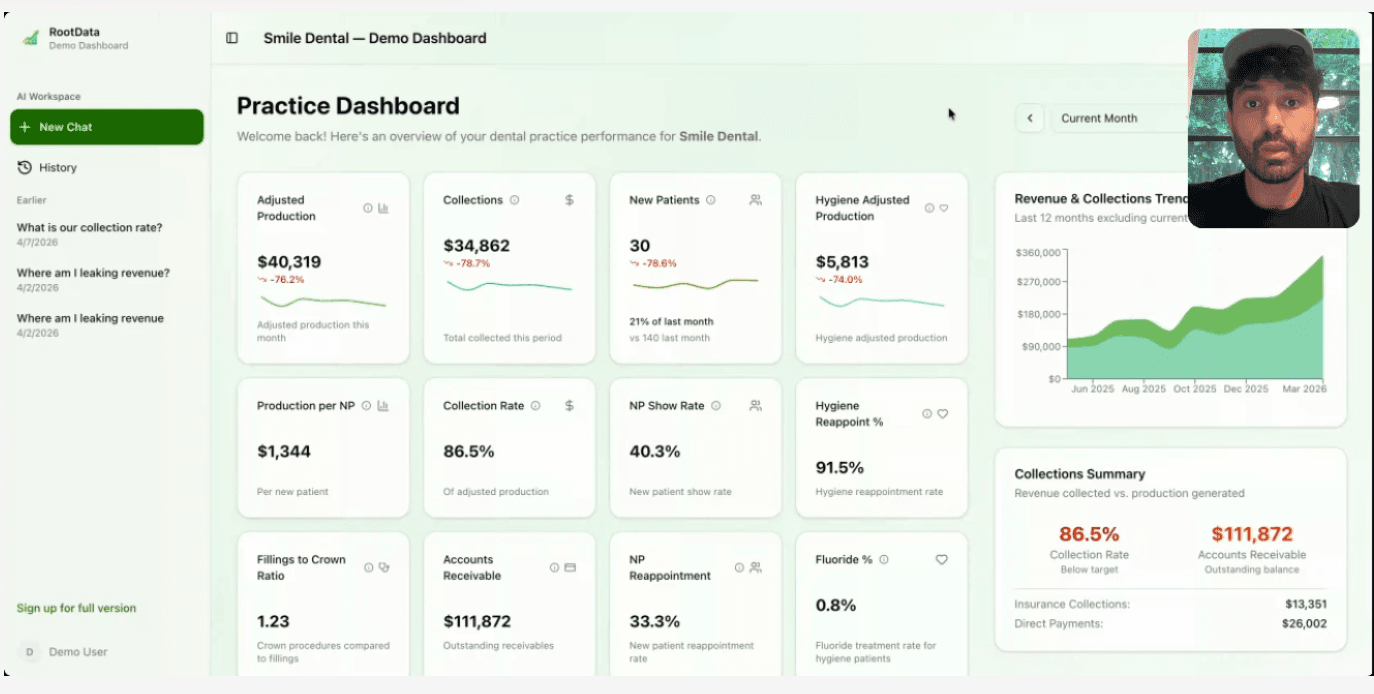
You open your dental analytics software with a straightforward question: how is the practice doing, and what needs attention?
Instead, you find yourself clicking through reports, comparing charts, and trying to connect numbers that sit in different parts of the system.
The information is there. Getting to a useful answer takes more effort than it should.
For a practice owner balancing patient care, staffing, and daily operations, that friction matters. A performance review gets postponed, a question goes unanswered, and the team continues working without a clear priority.
Root Data was created to make that process easier.
Dental Analytics Should Help You Know Where to Focus
A useful analytics experience starts with a clear view of performance.
What is improving? What has changed? Which area deserves a closer look?
Root Data brings key practice measures together, including adjusted production, collections, new patients, hygiene performance, appointments, case acceptance, and accounts receivable.
That gives owners a starting point for understanding the business without assembling a report from scratch.
If collections are falling behind expectations, you can investigate outstanding balances and payment timing. If hygiene performance changes, you can examine attendance and reappointment. If new patient volume rises without a similar change in completed care, you can explore what happens after patients book.
The value of dental analytics comes from making those questions easier to investigate.
Dental Practice Management Needs Context
A number becomes useful when you understand what it means for the practice.
Production and collections describe different stages of the business. Treatment acceptance and treatment completion are separate outcomes. A booked appointment does not guarantee an attended visit.
Reviewing related dental KPIs helps you understand where the process may be slowing down.
For example, a decline in production could reflect fewer completed visits, reduced provider availability, or a change in treatment mix. Each explanation points toward a different response.
Good dental practice management depends on identifying the right issue before asking the team to change something.
A dashboard provides the overview. The next step is exploring the context.
Ask Your Dental Analytics Software a Question
Root Data’s AI chat gives you another way to work with your practice information.
Ask, “How is our production this month compared with the same period last month?”
Then follow up: “Did completed appointments change?” or “Which providers account for most of the difference?”
You can also explore planning questions.
What might a higher case acceptance rate mean at our current treatment-plan volume? How many additional hygiene appointments would we need to reach our target? Where are patients leaving without another visit scheduled?
The conversation uses connected practice data to help you investigate the answer.
For financial scenarios, the assumptions matter. A 10% relative increase differs from a ten-percentage-point increase. Accepted treatment still needs to be scheduled and completed before it becomes production, and collections may follow later.
Being able to ask those follow-up questions makes the estimate more useful.
You get a clearer basis for deciding what the team should work on.
Built for Owners and Multi-Location Teams
Root Data was developed alongside a 50-location dental support organization and is also available to single-practice owners.
For an individual owner, the focus is understanding what is happening inside the office. You can explore the practice demo dashboard to see how that information is organized.
For regional managers and leadership teams, the questions extend across locations.
Which practices need support? Where is attendance slipping? Which offices have available capacity? Where are collections changing differently from production?
DSO analytics helps teams examine those differences and prepare more focused conversations with practice managers.
The scale changes. The purpose stays the same: help the person responsible for performance reach a useful answer sooner.
Connect the Systems Behind Your Questions
Root Data currently connects to Open Dental, with integrations for additional practice management systems coming soon.
You can review the PMS integration options to see what is available for your practice.
We also offer custom AI automations and integrations by request.
That may involve connecting another source of operational information, bringing marketing data into a performance review, or reducing repetitive reporting work.
The best starting point is a task your team repeatedly struggles to complete. Identify the information needed, where it lives, and what someone should do with the result.
That keeps the project focused on making daily work easier.
Watch the Dashboard and AI Chat in Action
The full Root Data walkthrough shows how the dashboard and AI chat work together.
Start with the overview. Find a metric that raises a question. Use the conversation to explore it, then decide what deserves attention.
You do not need to investigate every part of the practice at once. Begin with a question that matters this week and use the answer to guide a specific next step.
Get started with Root Data and see what your practice data can help you understand.
Want more insights like this?
Connect your practice management system to Root Data and get clear, actionable insights on your production, collections, and hygiene.
Explore Root Data