
Dental Analytics Built for the Practice Owner Who Needs Answers
Root Data was developed alongside a 50 location dental service organization and is currently used in all of their practices for daily operations. Now, this same dental analytics...
You should not need an analyst to understand how your dental practice is performing.
You need to know whether the schedule is translating into completed care, whether patients are returning, and whether the practice is collecting what it expects.
Root Data was developed alongside a 50-location dental support organization and deployed across its network. That same dental analytics platform is available to single-practice owners.
It brings practice performance into a connected dashboard and lets you explore your numbers through an AI chat.
The purpose is straightforward: make it easier to understand what is happening and decide where to focus.
The Dental Practice Management Problem
An owner can walk through the office and sense that something is off.
The schedule feels lighter. More patients seem to be canceling. Hygiene has openings that were not there before. The team is busy, but collections are not keeping pace with expectations.
Those observations matter. Turning them into a useful response requires more detail.
How much has attendance changed? Is the problem concentrated in new patients or existing patients? Are patients returning later, or dropping out of follow-up? Is the collections change related to payment timing or unresolved balances?
Practice management software records much of this activity. Finding and connecting the relevant information can still take time.
During a clinical day, that investigation competes with patient care, staffing questions, and everything else that needs the owner’s attention.
Root Data helps make performance review a manageable part of dental practice management. You can begin with an overview, identify a change, and investigate the questions behind it.
A Clear View of the Dental Metrics That Matter
A useful dashboard brings related measures together so you can understand how different parts of the practice affect one another.
Production, collections, patient activity, and scheduling each tell part of the story. Reviewing them together helps you choose where to look next.
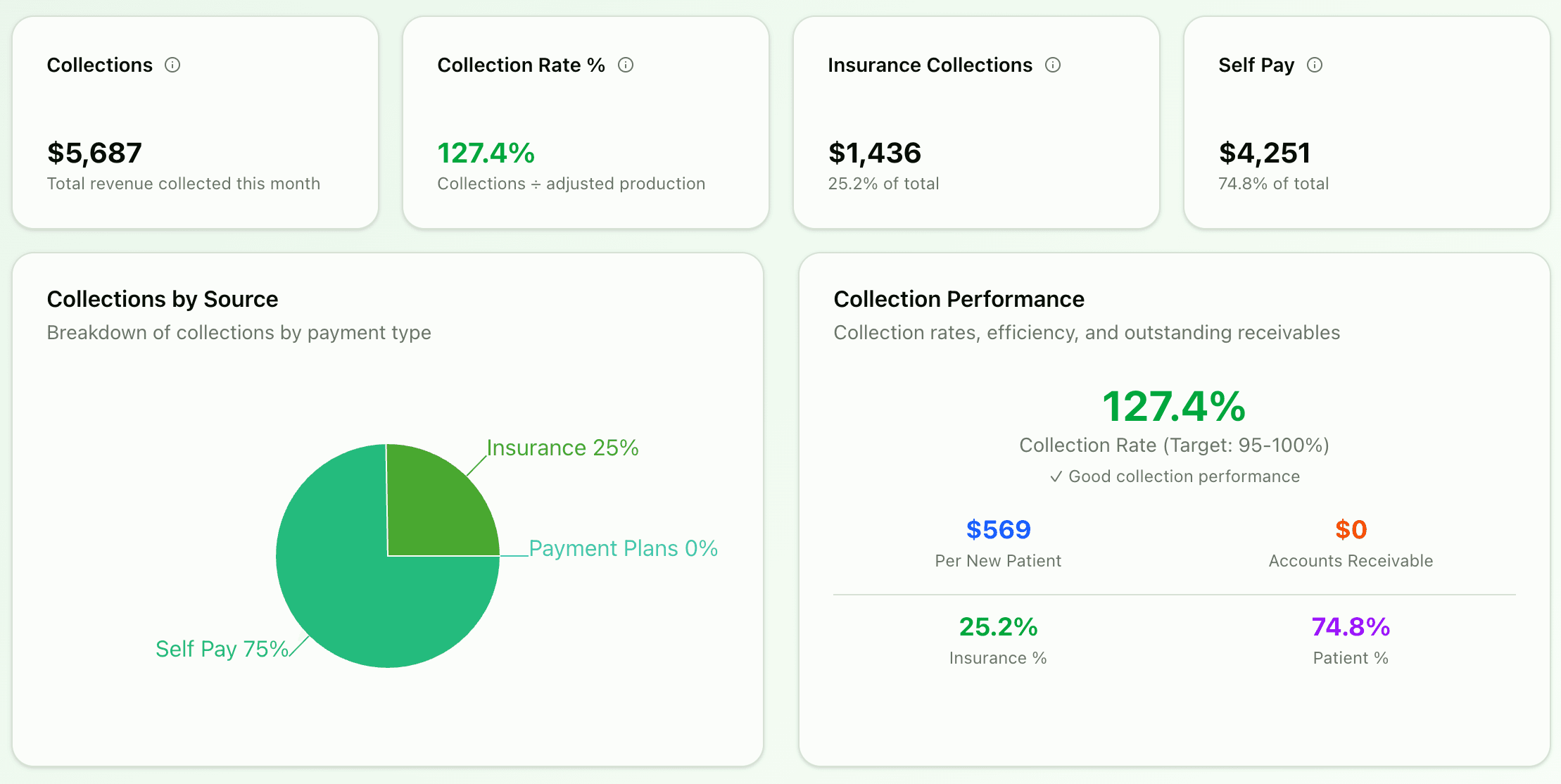
Adjusted Production and Collections
Adjusted production reflects the value of completed care after relevant adjustments. Collections reflect payments received.
These measures do not necessarily move together in the same month. Insurance timing, patient payment arrangements, and outstanding balances can all affect the relationship.
Reviewing the trend helps the owner decide whether a difference is expected or needs investigation.
New Patient Performance
New patient volume shows how many patients are entering the practice. Show rate helps explain whether booked appointments become attended visits.
Reappointment and subsequent treatment activity add context about what happens after that first visit.
Together, these measures help connect dental marketing activity with practice outcomes. They are more informative than lead volume alone.
Hygiene Performance
Hygiene production, completed visits, and reappointment patterns help explain continuity of care and future scheduling.
If production declines, the next question may concern attendance, staffing, appointment availability, or the mix of care provided.
If reappointment declines, the team can investigate what prevents patients from scheduling their next visit.
Treatment Acceptance and Scheduling
Case acceptance helps the practice understand how patients respond to recommended treatment.
It should be considered alongside scheduling and completion. A patient may accept a plan but leave without an appointment, or schedule treatment and later postpone it.
Those stages require different follow-up.
Accounts Receivable
Outstanding balances add another dimension to collections performance.
Reviewing aging and balance categories helps the billing team identify where follow-up is needed and gives the owner context for changes in cash flow.
Understanding these dental KPIs makes the dashboard more useful. Each number becomes a starting point for a specific operational question.
Ask Your Dental Analytics Software a Question
Sometimes you know exactly what you want to investigate. You just do not want to spend the afternoon building a report.
Root Data’s AI chat lets you ask questions about connected practice data in plain English.
Why did production decline last month?
How did new patient attendance change?
Which providers had the largest adjustments during this period?
How many hygiene patients left without another appointment?
What assumptions would we need to estimate the impact of improving reappointment?
You can ask follow-up questions, compare periods, and explore the information behind the answer.
The Root Data appointment audit walkthrough shows how a conversation can develop from a performance question into a more focused investigation.
Financial scenarios should make their assumptions clear. An additional booking is not automatically completed production, and production is not the same as cash collected.
The useful outcome is a better understanding of the opportunity and what the team would need to do to realize it.
What a Few Dashboard Numbers Can Reveal
Consider an example view showing a hygiene reappointment rate of 71.4%, a new patient show rate of 77.3%, and a new patient reappointment rate of 64.7%.
Each number raises a different question.
At 71.4% hygiene reappointment, approximately 29% of the patients included in the measure did not have their next visit booked. The team might review appointment availability, checkout conversations, and follow-up.
A 77.3% new patient show rate suggests that nearly 23% of eligible scheduled new patients did not attend as counted by that measure. The practice should distinguish cancellations, reschedules, and no-shows before choosing a response.
A 64.7% new patient reappointment rate prompts a review of what happens after the first visit. Did the patient need another appointment? Was one offered? Were suitable times available?
The value is being able to identify those questions quickly.
Explore the Root Data demo dashboard to see how practice performance can be organized into a view an owner can review regularly.
Clinical Activity Metrics Need Clinical Context
Some measures require particular care in interpretation.
A fluoride percentage of zero does not, by itself, establish a clinical gap or a revenue opportunity. The explanation may involve patient needs, services recorded, reporting definitions, or the period selected.
Likewise, a fillings-to-crown ratio cannot establish whether a provider is underdiagnosing treatment. Appropriate treatment depends on the individual patient and clinical findings.
These numbers can prompt a review. They should not become treatment quotas or substitutes for clinical judgment.
This distinction makes dental analytics more useful: operational reporting helps identify questions, while providers determine what care patients need.
Better Practice Growth Starts With Finding the Constraint
When growth slows, spending more on marketing is an obvious response.
Whether it is the right response depends on what is limiting the practice.
An office with available capacity and strong attendance may benefit from additional demand. A practice with plenty of bookings but frequent missed visits may need to improve its scheduling and communication processes first.
Another practice may have accepted treatment waiting for appointments. Another may need to address outstanding collections.
The value of each improvement depends on the practice’s baseline, treatment mix, costs, and available capacity. There is no universal rule that a particular percentage increase in one metric is worth more than an increase in another.
Root Data’s approach to dental software focuses on helping owners identify which issue deserves attention in their own business.
That gives practice growth a more concrete starting point than simply deciding to spend more or work longer.
Connect Your PMS and Build Around Your Workflow
Root Data currently connects to Open Dental. Integrations for Dentrix, Dentrix Ascend, Eaglesoft, Denticon, Curve Dental, and CareStack are coming soon.
You can review available and upcoming practice management software integrations to see where your system fits.
We also offer custom AI automations and integrations by request.
A practice may want to connect marketing information with patient outcomes, reduce recurring reporting work, or bring another operational system into the analysis.
The starting point is the task you want to make easier.
What information does the team need? Where does it live? Who uses it? What should happen once an issue is identified?
Those questions help define a useful integration and keep the project focused on how the practice actually operates.
A Foundation That Can Grow With Your Organization
A single-practice owner needs clarity within one office. A growing dental group needs to understand how performance differs across locations.
DSO analytics extends the review to regional and group-level questions.
Which practices need support? Where is attendance improving? Which offices have capacity? Where are collections falling behind production?
The underlying discipline remains the same: identify a meaningful change, investigate it, choose an action, and review the result.
The difference is being able to do that across the organization without losing the context of each practice.
Make Your Next Performance Review Useful
You do not have to begin with every metric.
Choose a question that matters this week. Investigate the trend, discuss it with the person closest to the workflow, and agree on an action.
Then return to the numbers to see whether the change helped.
That is how dental analytics becomes part of running the practice.
Get started with Root Data and bring a question you have been meaning to answer about your business.
Want more insights like this?
Connect your practice management system to Root Data and get clear, actionable insights on your production, collections, and hygiene.
Explore Root Data