
DSO Directory: A Public Reference for Dental Support Organizations
In 2018, 22% of new dental school graduates went straight to a DSO. In 2024, that number was 58%. Practice ownership among US dentists has dropped from 85% in 2005 to 73% in 2023, and the share of practices affiliated with a dental support organization keeps climbing.
In 2018, 22% of new dental school graduates went straight to a DSO. In 2024, that number was 58%. Practice ownership among US dentists has dropped from 85% in 2005 to 73% in 2023, and the share of practices affiliated with a dental support organization keeps climbing.
Consolidation is no longer a forecast. It's the dominant force shaping the industry, and yet there has not been a clean public place to see who the players actually are.
Today, we're launching the Root Data DSO Directory at rootdata.ai/dso-directory. It's a free, public list of dental support organizations with their logos, official websites, regions, and how each one describes its own work.
We built it because no one else had.
How Many DSOs Are There in the US?
There are roughly 178,000 dental practices in the United States, and as of 2026, about 38% of them are affiliated with a DSO in some form. That puts the number somewhere between 65,000 and 70,000 practices operating under DSO support today. The top 10 DSOs alone support nearly 7,000 of those locations.
The largest dental support organizations have reached a scale that was unthinkable a decade ago.
Heartland Dental supports more than 1,900 offices. TAG, the parent of Aspen Dental, partners with over 1,300 practices and 20,000 professionals across 46 states.
PDS Health supports more than 1,000 locations across 24 states. Smile Brands operates more than 600. Sonrava Health crosses 500. Smile Doctors leads the orthodontics-focused category with over 550 locations in 36 states.
Below that top tier, the landscape gets dense quickly. Industry estimates put the count of mid-market DSOs (10 to 74 locations) at around 260, with another 40 or so large DSOs above the 75-location mark.
The Becker's annual lists, which highlight standout organizations rather than attempting a full census, regularly feature 40 to 50 names that change meaningfully year to year as new groups scale and existing ones combine.
Why We Built a Public DSO Directory
The information was already out there. It was just scattered across Becker's lists, individual DSO websites, broker rankings, LinkedIn company pages, press releases, and PE portfolio sites. There was no single public reference where someone could browse the landscape, link to a specific organization, or share a profile.
That gap matters because the audience asking these questions keeps growing. Brokers and investment bankers constantly map the buyer universe. Practice owners considering an affiliation want to understand who's active in their region.
Vendors and service providers need to know who they should be talking to. Candidates evaluating jobs want a sense of the organization beyond what shows up on a careers page. Journalists, researchers, and analysts need a starting point. None of them had one.
A clean, neutral directory is a small piece of infrastructure, but it's the kind of thing that should exist for an industry of this size and trajectory.
What's in Each DSO Profile
Each profile draws from public information on the DSO's own website. That includes the organization's logo, official website, region or state footprint where available, and how the DSO describes its own work in its own language. The point is to surface what each organization says about itself, not to add a third-party interpretation on top.
Anyone on a DSO team can email hello@rootdata.ai to claim, correct, or expand their profile. The directory launches with 57 profiles, and more are being added on an ongoing basis.
The Root Data Take on DSO Analytics
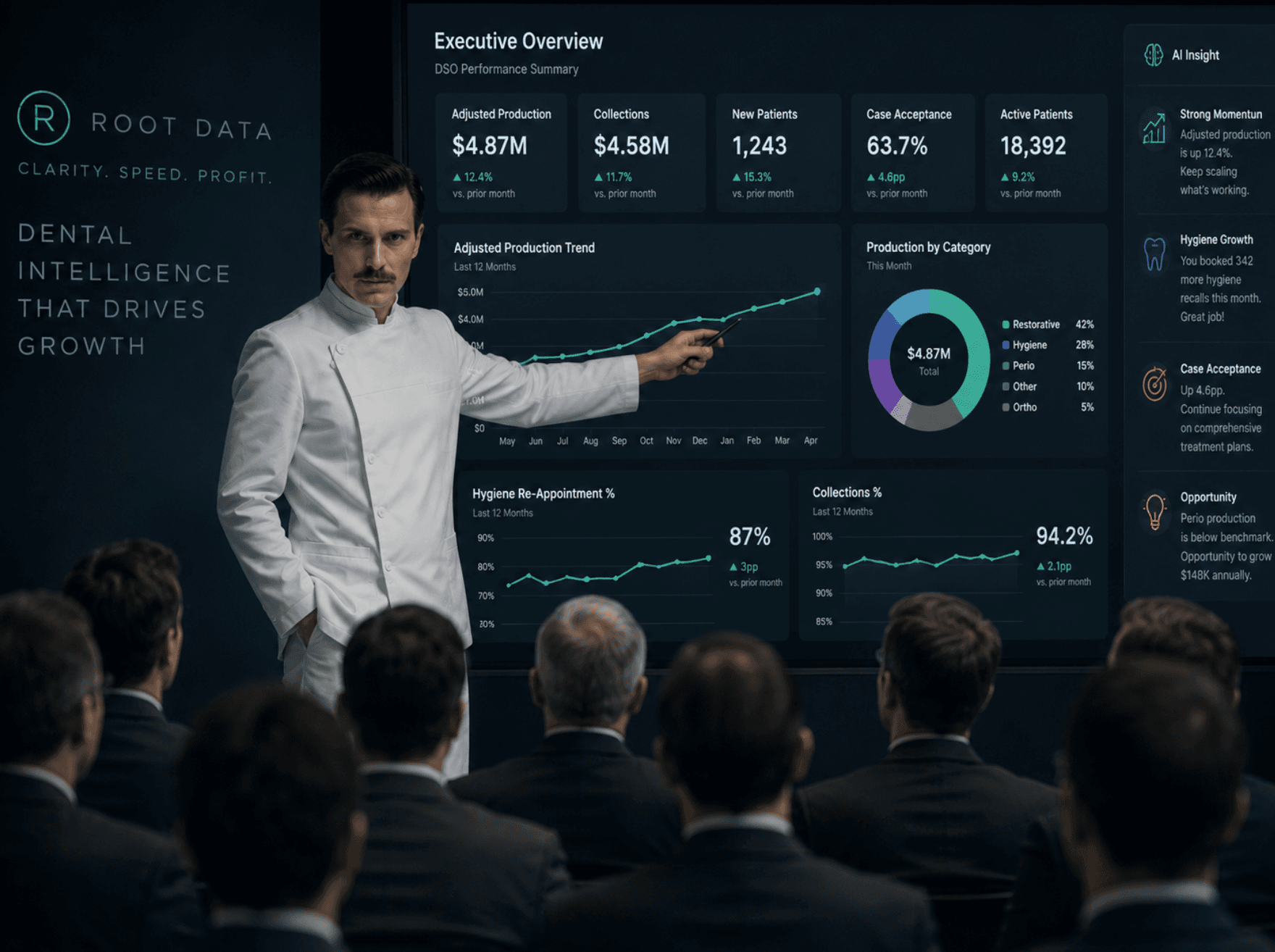
Root Data is an analytics and optimization layer for dental practices, built for both independent operators and the DSOs that support them at scale.
The platform integrates with Open Dental and other practice management software, surfaces where revenue is leaking, and provides operators with a clear path to the next fix. For DSO teams, the same engine runs across an entire portfolio, with regional and group-level views that let central operations teams see which practices are leading, which are lagging, and where to focus.
The directory is a public-facing piece of the same thesis. The DSO model is the operating system of modern dentistry, and the industry deserves clearer infrastructure around it.
Browse the DSO Directory
The directory lives at rootdata.ai/dso-directory.
If you run a DSO and want your profile updated, expanded, or corrected, email hello@rootdata.ai.
If you want to see what Root Data looks like applied to a DSO portfolio, the DSO demo is at rootdata.ai/dso/demo.
Want more insights like this?
Connect your practice management system to Root Data and get clear, actionable insights on your production, collections, and hygiene.
Explore Root Data