
Adding 50 New Patients a Month Increases Revenue by $79,000
Most dental practice owners know that new patients are important. However, many do not know the exact value of each new patient, how closely their revenue is tied to the number of new patients, or the cost of bringing in 50 more new patients per month. Without this information, planning for growth is largely a guessing game.
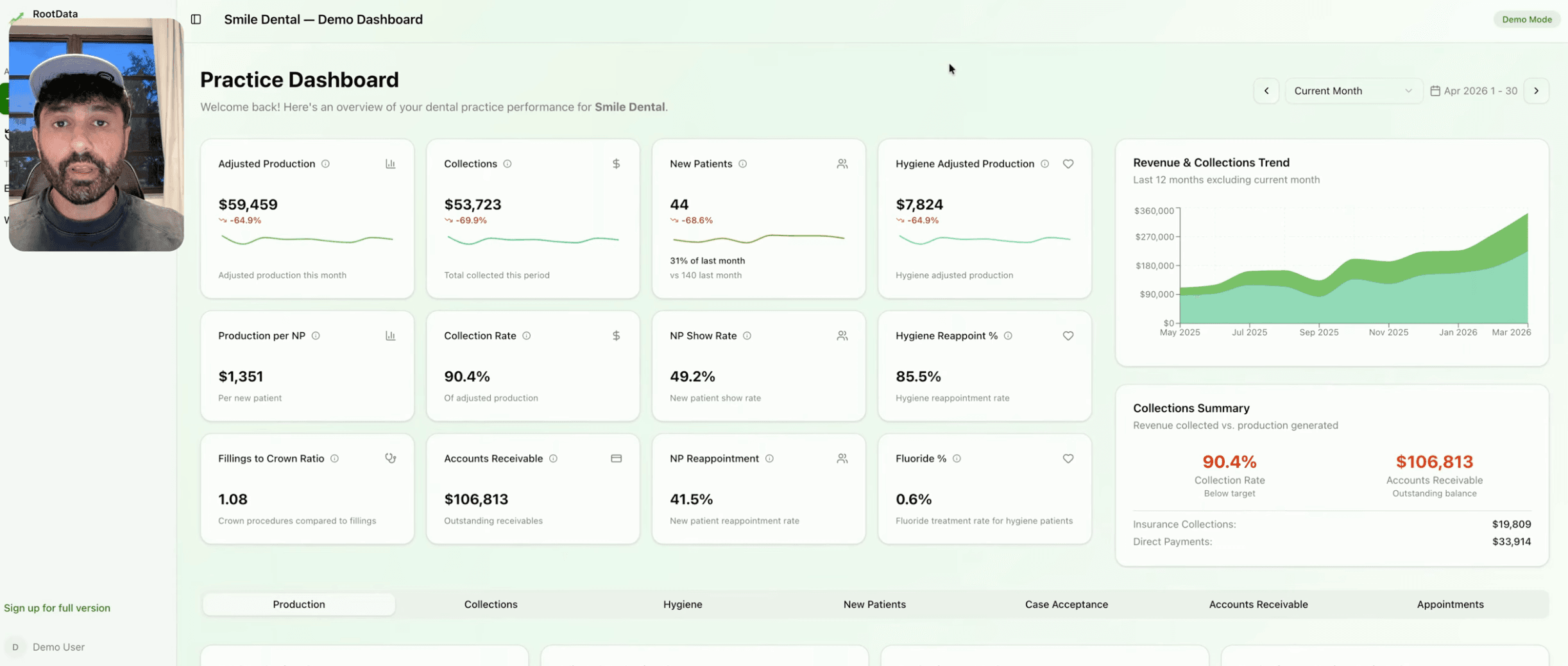

Watch this video
Opens a dedicated video page for this article.
Most dental practice owners know new patients matter. Almost none know what each one is actually worth, how tightly their revenue tracks new patient volume, or what it would cost to add 50 more next month. Without those numbers, growth planning is guessing.
This post breaks the math down using data from one practice running Root Data and shows how new patient volume actually moves the bottom line.
The Dental Metric Most Practices Overlook
Adjusted production per new patient is one of the most useful dental metrics in a general practice, and almost nobody tracks it. The question it answers is simple. What is each new patient worth on average?
In this practice, tracked over 3.5 months by Root Data, adjusted production per new patient was $1,585.67. Total adjusted production: $474,908. New patient count: 299.
Knowing this number changes how you think about marketing, capacity, and practice growth. Every acquisition decision now has a real ROI attached to it, not just a hunch.
The Correlation Between New Patients and Practice Growth Is Perfect We ran a month-over-month correlation between adjusted production and new patient volume. The Pearson coefficient came back at 1.0. A perfect positive correlation. New patients up, production up, at the same rate. The monthly numbers:
- January: 107 new patients, $114,394 in adjusted production
- February: 94 new patients, $131,741 in adjusted production
- March: 129 new patients, $169,315 in adjusted production
March was the strongest month for both. Production grew 48% from January to March, driven mostly by a 21% increase in new patient volume.
February was the exception. New patients dropped, but production still rose. That tells you the practice isn't entirely dependent on new patient flow. It is a healthy signal. The dominant pattern is the same: new patients drive practice growth.
What You Lose Without Real-Time Dental Analytics
Here is where the cost lives. If your new patient volume drops from 129 to 94, as it did between months in this practice, and you don't catch it in time, you have already taken a production hit before you understand why.
At $1,585.67 per new patient, losing 35 of them is roughly $55,500 in production gone in a single month.
Most practices find this out at the end of the month during a production review. By then, they are three to four weeks behind. The revenue is already gone, and they are reacting from a disadvantaged position.
Practices that protect their production track new patient volume in real time. That is what dental analytics is for. Not end-of-month reports, but a number on a screen that updates daily and tells you when the trend is breaking before the month ends.
The 50-Patient Dental Marketing Math
Use the same $1,585.67 per new patient. Add 50 new patients in a month. That is roughly $79,284 in additional production.
The dental marketing ROI works out cleanly. Total collections per new patient over the same period were $1,278.57. The standard dental marketing benchmark for cost per acquisition is around 10% of first-year patient value, so a reasonable CAC target is $128.
50 new patients at $128 each equals $6,400 in dental marketing spend per month. That spend produces about $79,000 in additional production. A 12-to-1 return on every dollar.
That math only counts the first few months. A retained patient produces revenue for years. Lifetime value usually runs three to five times the first-year value. The real return on $6,400 in dental marketing spend is far higher over time.
Capacity Is Not the Constraint Most Practices Think It Is
When practices target 50 more new patients a month, the first reaction is capacity. The data says capacity is rarely the real constraint. Three patterns from this practice:
The 11 am to 12 pm slot and the 4 pm slot are not fully utilized. Two of the main providers have cancellation rates of 17% to 19%. Roughly one in five scheduled appointments cancels before it happens.
Over 3.5 months, around 230 appointments were canceled. Recover half of those and you absorb most of the 50 new patients a month without changing the schedule structure.
50 more new patients a month works out to two to three additional appointments per working day. For most practices, that is well within reach if there are typical midday and late-afternoon gaps and cancellations are being actively managed instead of accepted.
What Reasonable Dental Marketing Spend Actually Looks Like
At $1,278 in collections per new patient, the dental marketing spend ranges that make sense:
5% of first-year value: $64 CAC. Aggressive. Leaves no room for error across channels.
10% of first-year value: $128 CAC. The target range for most practices. Enough flexibility to test channels and still hit a strong return.
15% of first-year value: $192 CAC. The upper limit. If a channel consistently runs hotter than this, kill it or rebuild it.
If you are spending under $75 per new patient and your volume is below target, you are underinvesting. The return at this level is strong enough that being too conservative on dental practice marketing is more expensive than spending too much.
You Cannot Optimize What Practice Management Software Hides
Practices that grow predictably are not the ones with the biggest marketing budgets. They are the ones who know what each new patient is worth, track volume weekly, understand their capacity ceiling, and know whether their dental marketing spend is producing.
Most practices make these decisions blind. They set marketing budgets on what feels reasonable. They find out about new patient drops after the month closes. They have no idea whether each patient costs 5% or 30% of their value to acquire.
The data is there. It is buried inside the practice management software. The reports are built for accountants, not practice owners. So nobody runs them, and the dental metrics that drive practice growth go unwatched.
That is the gap dental analytics is supposed to close.
See Your Numbers for Free
Root Data reads directly from your practice management software and surfaces adjusted production per new patient, new patient volume trends, provider capacity, cancellation rates, and the production you leave on the table every month.
How to get started:
Go to rootdata.ai and click Get Started
Create your account
Connect your practice management software. Setup takes a few minutes. Open the AI chat and ask what your adjusted production per new patient is.
The same dental analytics platform that a DSO uses across all 50 of its practices is now available to single-location owners. Your first 30 days are free.
Most practices find a number they didn't expect within the first week. Some discover they are underinvesting in acquisition. Others find out their cancellation rate is quietly absorbing capacity they thought they didn't have.
Either way, you will know where you actually stand.
Want more insights like this?
Connect your practice management system to Root Data and get clear, actionable insights on your production, collections, and hygiene.
Explore Root Data